
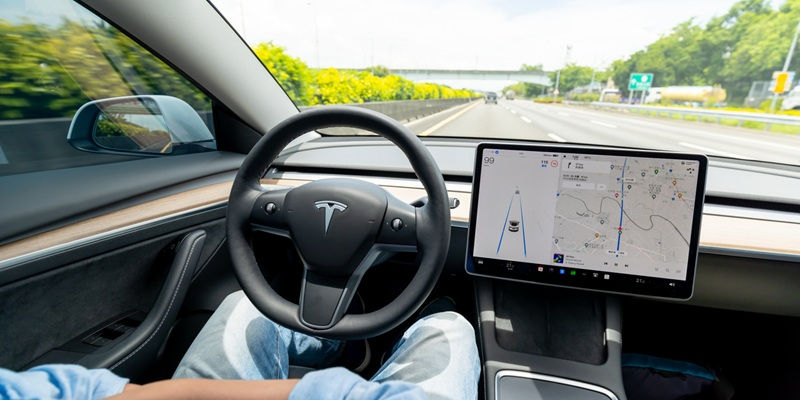
My friends are already using self-driving cars

“Did you use FSD to get here?”...
I (Chris Reilly) asked RiskHedge publisher Dan Steinhart over lunch.
He just bought a Tesla Model Y. And he absolutely loves full self-driving (FSD) mode.
He uses it every time he drives. It handles highway driving, merges, stop-and-go traffic, and city streets. Most of the time, Dan only takes over when it’s time to park.
I have another close friend who just started doing the same thing. He swears by FSD. Another is thinking of buying a Tesla now.
All this made me realize something:
Self-driving is a lot more “here” than I thought.
If you asked me a few months ago, I’d have said autonomous cars were still 5–10 years away. But people I know are already letting their Teslas do most of the driving. I’m not sure why this isn’t a bigger story.
Tesla’s FSD costs $99/month. But if you use Tesla car insurance as Dan does, it can end up costing only half that. His monthly premium is based on how safely he drives, and using FSD gives him a perfect 100 safety score.
That saves him $40/month on insurance, making FSD a “no brainer.”
Self-driving cars take distracted driving out of the equation. And now Tesla’s (TSLA) using the data from all that driving to reward safer behavior and incentivize people to sign up for FSD. Smart.
As Stephen McBride says, “Future’s bright!”
So why does Stephen think Tesla is in a prime position to win the self-driving race?
If you’re asking who operates the best robotaxi service today, Waymo wins. Although Tesla is catching up with last week’s Cybercab launch in Austin.
But Stephen says that’s the wrong question. The real competition isn’t a Waymo robotaxi versus a Tesla robotaxi.
It’s a self-driving taxi you occasionally hail versus a self-driving car you own.
Americans drive more than 3 trillion miles every year. Taxis and ride-hailing account for only a tiny fraction of that.
Most driving happens in privately owned cars... to work, school, the grocery store, on family trips, and everywhere else. That’s the market Tesla is going after.
Not to mention, a Waymo robotaxi costs $160,000 to make. You can get a new Model Y for less than $50K… or a used one for less than $40K.
As long as it was made in 2024 or later, it has all the hardware needed for full self-driving.
Tesla’s customers are already buying the cars. And Tesla can then sell them FSD as software.
As Stephen put it: “Waymo pays to deploy each car. Tesla gets paid to deploy each car.”
That distinction matters enormously if (when) self-driving becomes good enough to operate without human supervision. Dan and Stephen both agree it’s good enough already—as in significantly better than human drivers.
But telling people they don’t have to pay attention as the car drives them around shifts legal responsibility for crashes onto Tesla, which is the big leap.
Tesla already has millions of cars on roads across the country collecting driving data.
Stephen noted that Tesla customers had accumulated roughly 11.9 billion miles using supervised FSD, compared with about 220 million fully driverless miles for Waymo.
But there’s an even bigger picture when it comes to investing in Tesla stock...
Stephen and Chris Wood, our Chief Investment Strategist, don’t just view Tesla as a self-driving company.
In their new Q4 Disruption Playbook, they identify physical artificial intelligence (AI) as one of the major megatrends to watch right now.
The idea is simple: AI is moving out of data centers and into machines operating in the real world... autonomous vehicles, robots, satellites, and other systems that have to make decisions in real time.
In other words, the same AI technology that allows a Tesla to make split-second decisions on the road can help an Optimus robot understand its surroundings and perform tasks.
And Tesla is building the infrastructure to support that future, too.
Chris points to Terafab, the chip-making venture involving Tesla, SpaceX (SPCX), and Intel Corp. (INTC) as part of Tesla’s effort to build the AI computing capacity it will need. The company is also ramping up Optimus production, with its Fremont factory being converted to produce up to 1 million robots a year.
That’s why Stephen and Chris see Tesla as more than just a bet on electric or self-driving cars.
It’s a world-class disruptor building pieces of the entire physical-AI stack: chips, autonomous software, robots, and batteries.
But physical AI is only one of the opportunities they’re watching right now.
Stephen and Chris also highlight three disruptors positioned to capitalize on the AI infrastructure megatrend... as well as a high-speed connectivity play... and a dominant company that’s behind AI’s shift to light.
You’ll receive their Q4 Playbook right away when you take advantage of our special Disruption Investor Labor Day sale.

By upgrading to Disruption Investor, you’ll also get their full Disruptor 20 portfolio with specific buy and sell recommendations and access to every issue in the Members’ Area.
Just know that this Labor Day special ends tomorrow at midnight.
Finish the year strong and get onboard by clicking here.
Chris Reilly Executive Editor, RiskHedge
Share this article
Where Innovation Meets Investing
When Elon tells me he will take full responsibility for any damage the car does while on FSD, then I will pay for it. Tesla has done nothing but shift the blame to owners when their cars get into wrecks while on FSD. Put your money where your mouth is Elon!
On top of that the car will have to charge itself if I am to let it out on its own to “make me money”. I need 60% of the battery every day for my own daily needs. The millions of Teslas on the road right now are, and never will be, able to drive themselves. Only the ones with HW4 and that is a small minority of the Teslas on the road.