

Hello from Abu Dhabi.
My family is safe.
Saturday morning, a US military contact sent me a heads up: “It's about to kick off.”
Sure enough, we got emergency alerts on our phones—stay inside, missiles incoming.
A few hours later, we heard explosions.
Iran launched hundreds of missiles and drones at US military bases and targets across the UAE.
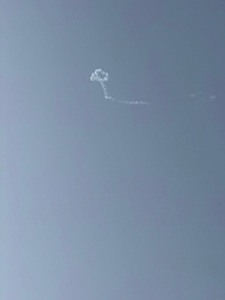
Abu Dhabi's “Iron Dome” swatted almost all of them out of the sky. We watched some interceptions from our window. Here’s a picture I snapped:
My mom rang me in tears. She’d just seen “Iran Bombs Abu Dhabi” flash across her screen.
Thanks for all the messages. Everything is normal for now in Abu Dhabi. Gyms packed. Malls busy. People living their lives. I walked along the beach with my kids yesterday.
The worst part of the whole thing is the schools switching to “virtual learning” for three days. COVID flashbacks. I'm running my own experiment. I bet my kids can cover their entire seven-hour school day in under two hours. The beach is their reward for finishing fast.
So… what does this new war mean for your investments?
We looked at over 50 major geopolitical and warlike events since the 1950s.
- US stocks drop around 7%, on average, in the days following the start of a conflict.
But one year after the onset of the war, they’re back in green in 85% of the cases. And with a median gain of 7%.
In other words, if the market follows its seven-decade pattern, any weakness in stocks will be short-lived.
Here’s how the S&P 500 fared during the first Gulf War in the early 1990s:
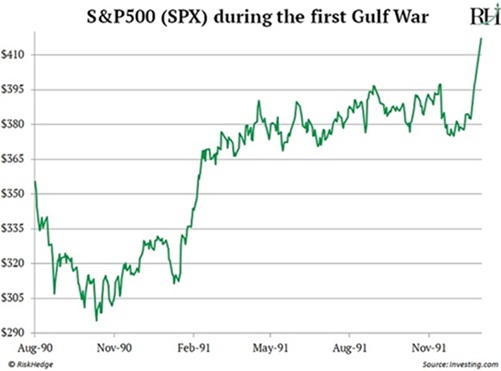
Down a little… then up a lot.
Here are US stocks a decade later, during the second Gulf War:
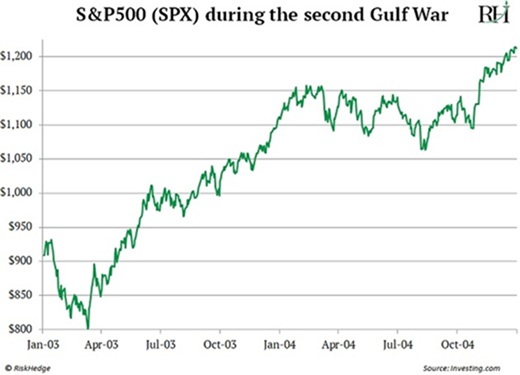
Down a little… then up a lot. Stocks fell in the beginning but rallied 26% over the following 12 months.
US stocks followed this pattern the last time conflict broke out between the Ukraine and Russia, in 2014:
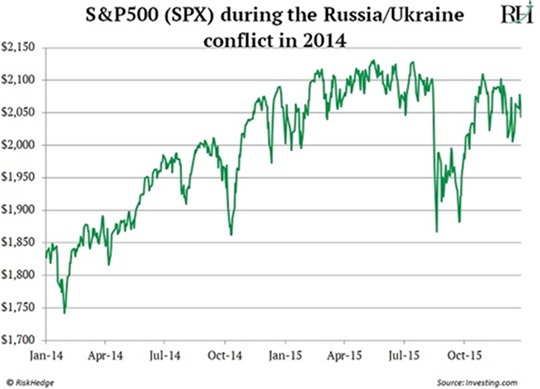
You can see the right decision during all these events was to buy, not sell.
Now, stocks did fall for most of the year after Russia invaded Ukraine in February 2022. But remember: They were also caught up in the worst bear market since 2008. Everything plummeted that year.
- When the guns start firing… get out your shopping lists.
I’m not downplaying war.
But this is an investment letter. We’re here to make money.
And the facts are clear: The absolute worst thing you can do is panic and sell.
Of course… there’s always a chance that markets won’t follow historical patterns.
|
What if Iran attacks the US and this war isn’t like the others?
What if it defies the odds and crashes the stock market?
It’s a valid concern. But that’s the nature of stock market investing. There’s always some potential disaster looming.
We, as long-term investors, get paid to accept this short-term risk.
I acknowledge and respect the fact that the market can decline 20% at any time for any reason, or for no reason at all.
I don’t use leverage. I own world-class disruptive businesses that will overcome any setback and continue to compound wealth.
If you own disruptors like this, don’t sell. Buy on the weakness.
While it feels more natural to hit the sell button... history has shown us time and time again that you want to buy during these times.
- And please, turn off the news.
You'll know less about reality with it on than with it off.
Here’s one more chart for good measure—from the excellent geopolitical analyst and friend of RiskHedge, Marko Papic.
This one charts the average performance of the S&P 500 around 57 major geopolitical events from 1956 – 2024:
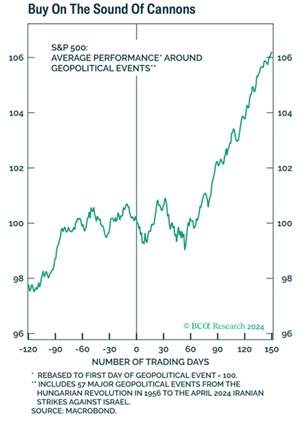
Down a little… then up a lot.
Stephen McBride
Chief Analyst, RiskHedge
PS: If you want an innovative investment strategy that can make money in any market conditions, please read this. You’ll learn a little-known way to buy into certain $10+ companies for $0.50 apiece or less. The average gain of this method has been 136%. Go here to see how.